
What is a prediction market? A marketplace where people trade contracts on future events — elections, rate cuts, sports finals, crypto levels — instead of shares in a company.
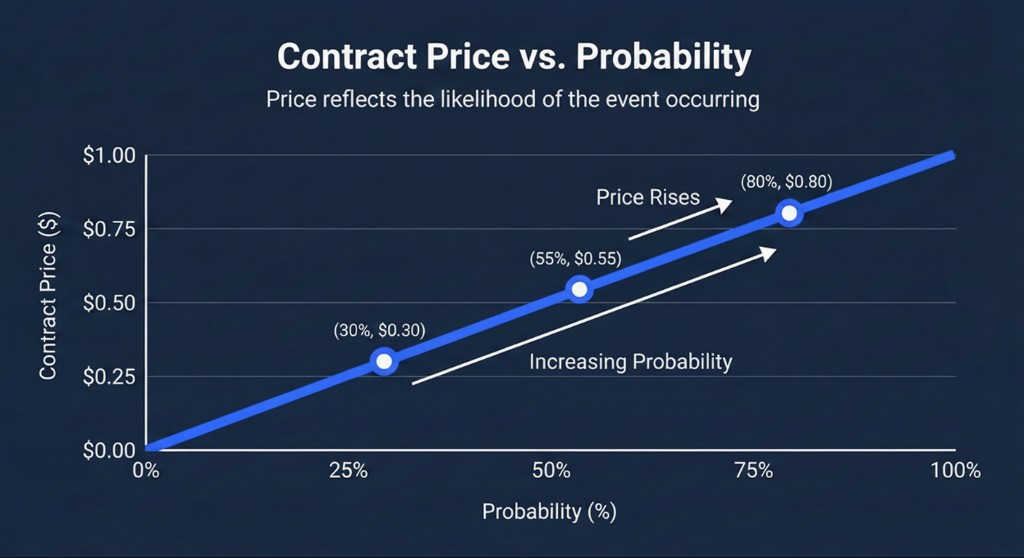
Each contract settles at a fixed value, usually $1, when the event resolves. Hold the correct outcome and you get paid; hold the wrong one and the contract goes to zero. That payoff structure is why the price reads like a probability: a “Yes” share at $0.62 implies roughly a 62% chance before fees, spread, and other trading costs.
Because traders put capital behind their forecasts, prices can absorb new information quickly. They are not automatically correct. Market quality depends on liquidity, participant diversity, contract wording, and the quality of the available information.
Related reading: How prediction markets work · How to read prediction market odds · Are prediction markets legal? · 2026 platform comparison
This article is the plain-English foundation: what the product is, why the price behaves like a probability, how a position makes or loses money, and which risks matter first. Our separate mechanics guide goes deeper into order books, executable prices, liquidity, slippage, and settlement.
What Is a Prediction Market in One Sentence
Traders buy and sell fixed-payout contracts on whether a real-world event happens; the live price is the market’s current implied probability, not a guarantee.
How Prediction Markets Work (Explained Simply)
Prediction markets reduce a future event to a contract with clear outcomes and settlement rules. Most contracts are binary — Yes or No — and trade between $0.00 and $1.00.
At a high level, every trustworthy market needs four things:
- A precise question: What must happen, and by what deadline?
- Tradable outcomes: Usually Yes and No contracts
- A price-forming mechanism: An order book, market maker, or liquidity pool
- A resolution source: The named authority or data source that decides the result
The Basic Structure
- A correct outcome usually settles at $1.00
- An incorrect outcome settles at $0.00
- Prices move as traders place orders and react to new information
- The displayed price is an estimate; the price you can execute may differ because of spread and depth
If you estimate that an event is more likely than the executable market price suggests, you can buy Yes. If you think it is less likely, you can sell an existing Yes position or buy No, depending on the venue.
A Practical Example
Let's say there's a market asking:
"Will Ethereum be above $4,000 by December 31?"
- "Yes" trades at $0.45
- "No" trades at $0.55
If you estimate that ETH has more than a 45% chance of finishing above the threshold, buying Yes may be attractive after accounting for fees and spread. If the executable bid later rises to $0.70, you can sell early rather than wait for settlement.
How Profit and Loss Works in Prediction Markets
The payoff is bounded, but the useful number is net P&L, not the headline payout.
Settlement and Early-Exit Formulas
- Gross settlement profit if correct = ($1.00 – entry price) × shares
- Gross early-exit P&L = (sale price – entry price) × shares
- Net P&L = gross P&L – trading and settlement fees
- Market loss if wrong = entry price × shares
Real-World Scenario
You buy 200 shares of a "Yes" contract at $0.35.
- Cost: $70
- If correct: payout = $200
- Gross profit: $130 before fees
- If wrong: the position loses its $70 entry value
For a fully collateralized long binary contract, the position loss is capped at the amount paid for the shares. Fees can increase the total cash cost, and products involving leverage, margin, or uncovered selling follow different risk rules.
Are Prediction Markets More Accurate Than Polls?
Sometimes, but not by default. Polls and prediction markets measure different things.
A poll estimates stated preferences from a sample at a particular moment. A prediction market continuously prices the probability of a final event based on trades. The financial incentive can improve information aggregation, but it does not eliminate bad assumptions, concentrated capital, weak liquidity, or crowd behavior.
| Feature | Polls | Prediction Markets |
|---|---|---|
| Primary signal | Stated preference | Traded event probability |
| Update cycle | Scheduled fieldwork | Continuous while trading is open |
| Weighting | Survey methodology | Capital and available liquidity |
| Main weakness | Sampling and response bias | Thin markets and concentrated positions |
Academic evidence is encouraging but context-dependent. Long-run election-market research shows that accuracy changes with the forecast horizon and the comparison method. Our view at Pariflow is to treat a market price as one live forecast: useful when it is liquid and well specified, but never a substitute for checking the underlying evidence.
What Can You Trade in a Prediction Market?
In 2026, prediction markets cover far more than politics.
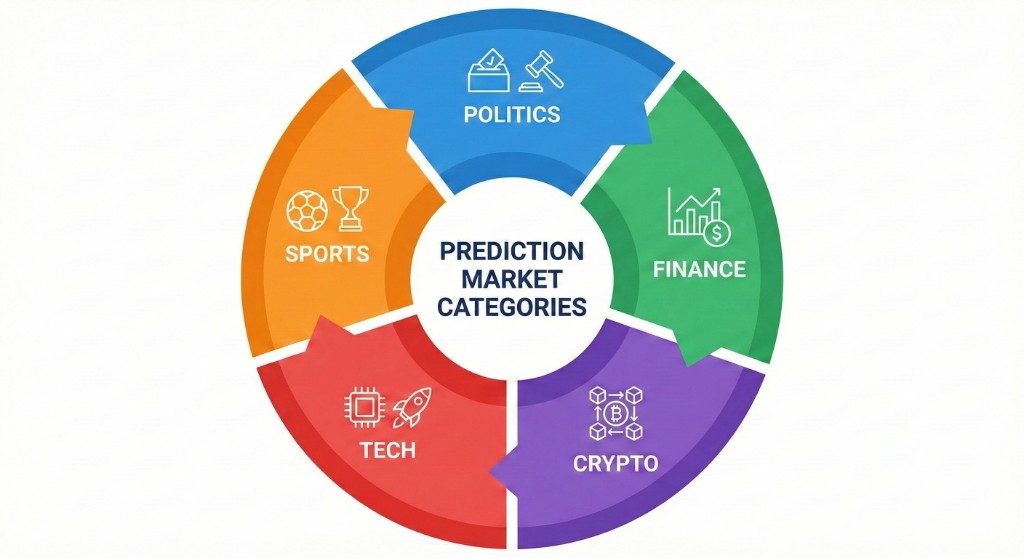
Common Categories
- Politics: Elections, legislation, leadership changes
- Macro & Economics: CPI releases, rate cuts, recessions
- Crypto & Finance: Price levels, ETF approvals, protocol upgrades
- Technology: Product launches, AI milestones
- Sports & Culture: Tournament winners, award shows
Some markets are serious forecasting tools. Others are closer to speculation. The value depends on liquidity, clarity, and rules.
How to Start Trading Prediction Markets (Step by Step)
The interface is usually simple. Choosing a suitable venue and understanding the contract require more care.
Step 1: Pick the Right Platform
Choose based on:
- Your jurisdiction and eligibility
- The venue's regulatory and operational structure
- Fees, spread, and market depth
- Supported funding and withdrawal methods
Step 2: Fund Your Account
- Use only the funding methods the venue officially supports
- Start small while you learn how prices, fills, and settlement work
Step 3: Read the Market Rules Carefully
Every contract has specific wording. Subtle details matter more than opinions.
Step 4: Look for Mispriced Probability
Ask one question:
Is this event more or less likely than the current price suggests?
If yes, you may have a potential trade. The estimate still needs to beat fees, spread, slippage, and the risk that you misunderstood the rules.
Step 5: Manage Risk
Don't go all-in on one outcome. Prices can swing sharply near resolution.
Trader insight: Fast markets can overreact to incomplete headlines, but a reversal is never guaranteed. Re-read the source, check the resolution wording, and avoid treating a sharp move as a strategy by itself.
Are Prediction Markets Legal?
Legality depends on the venue, contract type, and jurisdiction — not only on the concept. For the full 2026 breakdown, read Are Prediction Markets Legal?.
United States
- KalshiEX is a CFTC-designated contract market
- Venue status does not guarantee that every contract is available in every state or to every user
- Some platforms restrict U.S. access; treat those restrictions as rules, not obstacles to bypass
International
- Eligibility varies by country and platform
- Regulators may classify the same product as a derivative, exchange contract, or betting product
Check the venue's current eligibility rules and your local law before depositing. This guide provides general information, not legal advice.
Key Risks of Prediction Markets (Read This First)
Prediction markets are simple—but not risk-free.
1. Resolution Risk
Ambiguous outcomes can lead to disputes. Always check:
- Data source
- Resolution authority
- Timing
2. Liquidity and Execution Risk
In thin markets, spreads can be wide and quoted size can disappear. A correct forecast can still become a poor trade if the entry or exit price is weak.
3. Information Risk
You may be trading against someone with better public information, a better model, or faster execution.
4. Narrative Traps
Markets sometimes follow compelling stories instead of base rates and evidence. Popular does not mean accurate.
5. Platform and Eligibility Risk
Funding methods, withdrawals, contract availability, and access rules can change. Use supported account and payment methods, and do not assume a market available today will remain available everywhere.
Experienced trader rule: If you don't fully understand how a market resolves, don't trade it.
Is a Prediction Market the Same as Gambling?
They overlap, but intent alone does not define the product.
A sportsbook generally posts odds and takes the other side of the customer's bet. A prediction market usually lets participants trade contracts with prices formed by supply and demand. Positions can often be sold before resolution, which makes the experience closer to an exchange.
That structural difference does not make every trade analytical or low risk. A prediction market can be used for forecasting, hedging, research, or entertainment, and its legal classification still depends on the venue and jurisdiction.
Why Prediction Markets Matter (Final Thoughts)
Prediction markets turn disagreement about the future into a public, continuously updating price. That makes uncertainty easier to compare, discuss, and trade.
The price is still a forecast, not a fact. It becomes more useful when the question is precise, the resolution source is credible, liquidity is sufficient, and no single participant dominates the market.
Our standard at Pariflow is simple: before treating a price as meaningful, check the rules, check the liquidity, and decide whether your probability estimate is genuinely better after costs. That is the difference between reading a market and merely reacting to one.

Nikolay Golovin
Co-Founder & CEO
Nikolay is the Co-Founder of Pariflow with expertise in data science and machine learning. He has spent years studying prediction markets and their applications in forecasting real-world events. His work focuses on making prediction markets accessible and understandable for everyone.